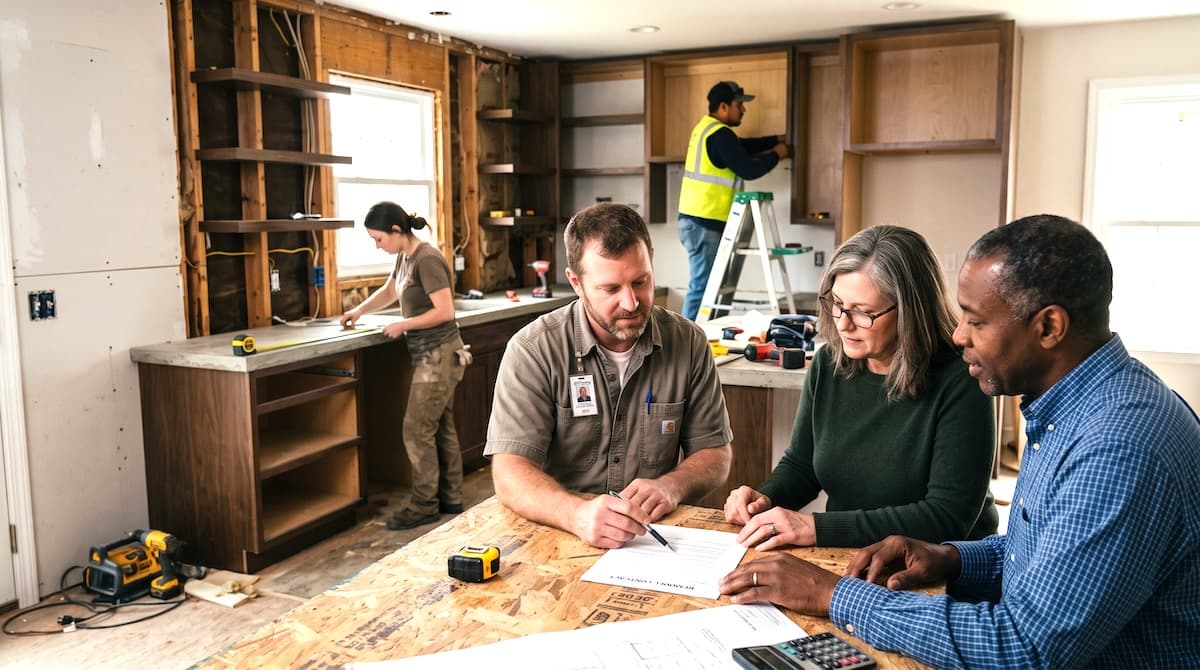
Every contractor has lost a job to a cheaper bid. But there's another kind of homeowner out there, and if you do residential work you've met them. They got burned on their last project, or their neighbor did. They've read the stories about the remodeler who took a deposit and vanished. That homeowner isn't shopping on price. They're shopping on trust.
There's a tool built for exactly that situation. Most residential contractors don't know it exists, and a good number of the ones who do couldn't qualify for it. That's the opportunity.
The Numbers Behind the Nervous Homeowner
Homeowners aren't imagining the risk. They're reading about it. And there's real work waiting for the contractors who can calm those nerves.
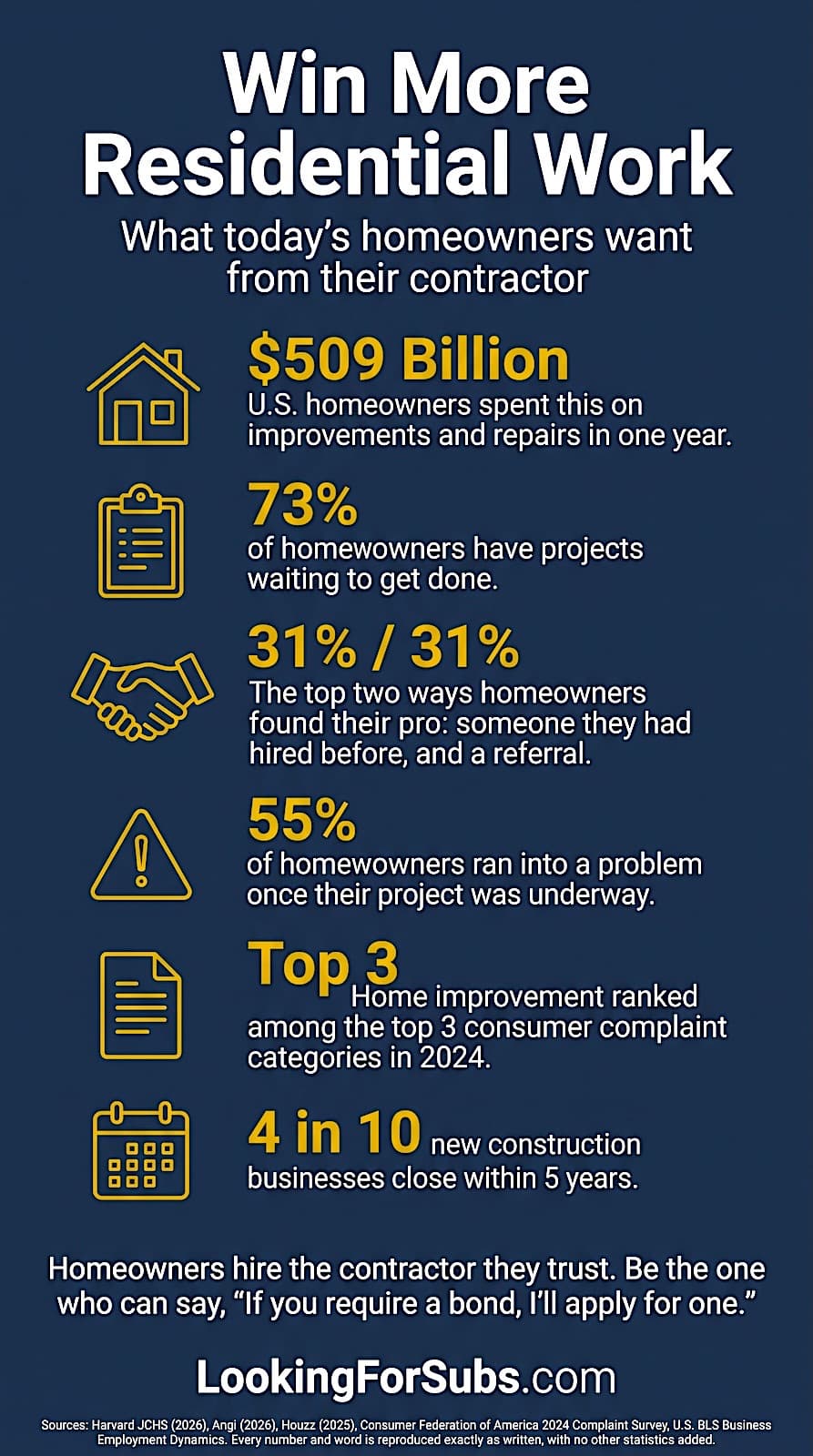
$509 billion. That's roughly what U.S. homeowners spent on improvements and repairs over the year ending in late 2025, according to Harvard's Joint Center for Housing Studies. They project about $518 billion by the end of 2026. (Harvard JCHS)
73 percent. That's the share of homeowners with projects waiting to get done, according to Angi's early 2026 homeowner research. When they did hire, the top two ways they found the pro were someone they'd worked with before (31 percent) and a referral from friends or family (31 percent). Reputation is the whole game. (Angi)
55 percent. In a 2025 Houzz survey, more than half of homeowners said they ran into some kind of problem once their project got underway. Trusting pros was the single most-cited challenge in planning a project. (Houzz)
Top 3. Home improvement ranked third among consumer complaint categories reported by 41 state and local consumer protection agencies in 2024, and second the year before. The complaints centered on quality of work, unfinished jobs and licensing. (Consumer Federation of America)
12,658. That's how many consumer complaints California's Contractors State License Board received in fiscal year 2024/25, in one state alone. (CSLB)
100+ arrests. After the 2024 hurricanes, unlicensed contractor stings in Pinellas County, Florida, led to arrests of more than 100 suspects. Under Florida law, unlicensed contracting during a declared emergency is a felony. (Consumer Federation of America)
More than 4 in 10. Of construction establishments that opened in the year ending March 2020, 43.5 percent were gone within five years. (U.S. Bureau of Labor Statistics)
Put that together and you can see what a homeowner is thinking before they sign a six-figure contract. There's plenty of work, and most of it goes to contractors homeowners already trust. A contractor who can say "if you require a bond, I'll apply for one" earns that trust faster than one asking the homeowner to take it on faith.
What a Homeowner Protection Bond Is
Homeowner Protection Bond is the program name America's Surety Bonds uses for a standard contractor performance and payment bond written on a private residential job. It's the same kind of contract bond used on commercial and public construction, applied to a remodel, an addition, a custom home, a roof replacement or a major renovation.
There are three parties. You, the contractor, are the principal. The homeowner is the obligee, the party the bond protects. A surety company guarantees your obligations under the contract.
The performance bond guarantees you'll complete the work the way the contract says, including any warranty obligations written into it. The payment bond guarantees your subcontractors, laborers and suppliers get paid for what they furnish on the job. The two can be written separately or together.
If you're a sub reading this, pay attention to that second one. On a job with a payment bond you have someone to claim against if the GC doesn't pay you, and it isn't the homeowner's house.
Why It Works Like a Background Check
A license bond is a commodity. Fixed amount, quick approval, small premium. A performance and payment bond is closer to a line of credit, and the surety underwrites you the way a lender would before it puts its name behind yours.
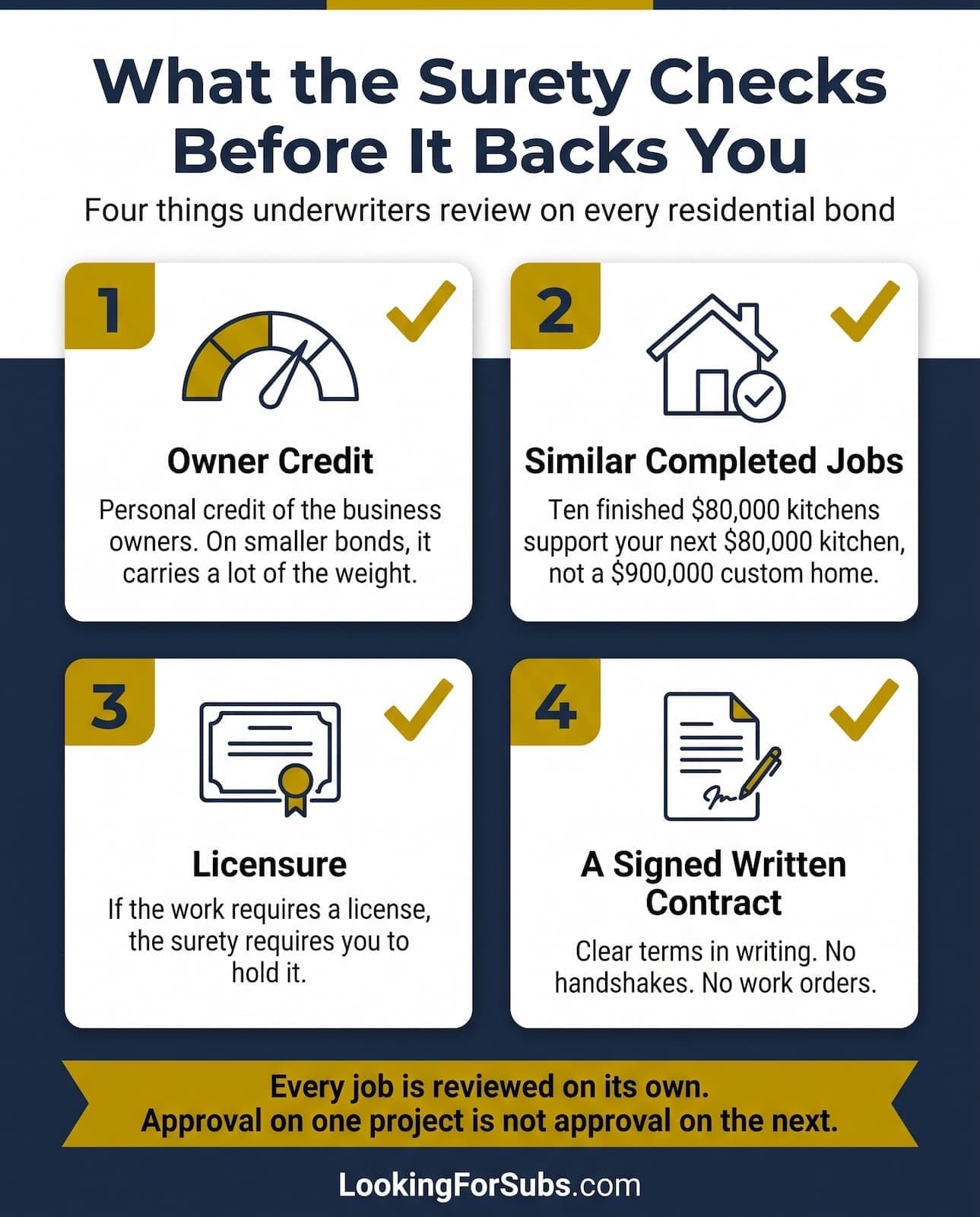
Before it issues anything, the surety looks at:
- Personal credit of the business owners. On smaller contract bonds this carries a lot of the weight.
- Completed jobs of similar size. Ten finished $80,000 kitchens says a lot about your next $80,000 kitchen. It says less about a $900,000 custom home.
- Licensure. If a license is required to do the work, the surety requires you to hold it.
- The contract itself. It needs to be a signed written contract with clear terms, not a handshake or a work order.
Every job is reviewed on its own. Approval on one project isnt approval on the next.
So when a bond issues, the homeowner knows a surety company has reviewed your credit, your experience, your license and your contract. After that review, the surety was willing to stand behind you on that specific job. Very few things a contractor can show a nervous homeowner carry that kind of weight.
It's also very different from a license bond. A license bond is a set amount chosen by the licensing authority and shared by everyone who might have a claim against you. It isn't sized to any one project. A residential performance and payment bond is written for one contract and one homeowner.
The Rule You Need to Know: the Homeowner Has to Require It
This is the part contractors get wrong. You can't buy this bond on your own to win a bid. The surety writes it only when the homeowner requires it in a signed construction contract that states the bond amount. A bond offered as a sales feature, to look more trustworthy or to beat other bidders, gets declined.
What you can do is let homeowners know the option exists. Something like:
"If you'd like a performance and payment bond on this project, you can write that requirement into the contract, and I'll apply for it."
That's honest and it's allowed. Just don't promise approval, because the surety makes that call job by job. Plenty of homeowners have never heard of a performance bond on a house. Once they learn they can require one, the contractor who brought it up calmly, without flinching, tends to stand out.
Who Pays: Build It Into the Contract Price
The contractor applies for the bond and pays the premium. That cost can be added to the contract price, so the project carries it.
Premium generally runs 3 to 5 percent of the bond amount, depending on the owners' credit, experience on similar jobs and how clearly the contract defines the work. On a $150,000 contract bonded at 100 percent, that's roughly $4,500 to $7,500.
The cleanest approach is to put the bond premium on the estimate as its own line item, priced from an actual quote. Homeowners who asked for the protection generally understand it costs something, and a visible line is easier to talk about than a number buried in overhead.
One warning. Get the quote before you lock in a fixed price. If you sign at a number and then find out the bond costs more than you guessed, you just ate the difference.
What the Contract Needs
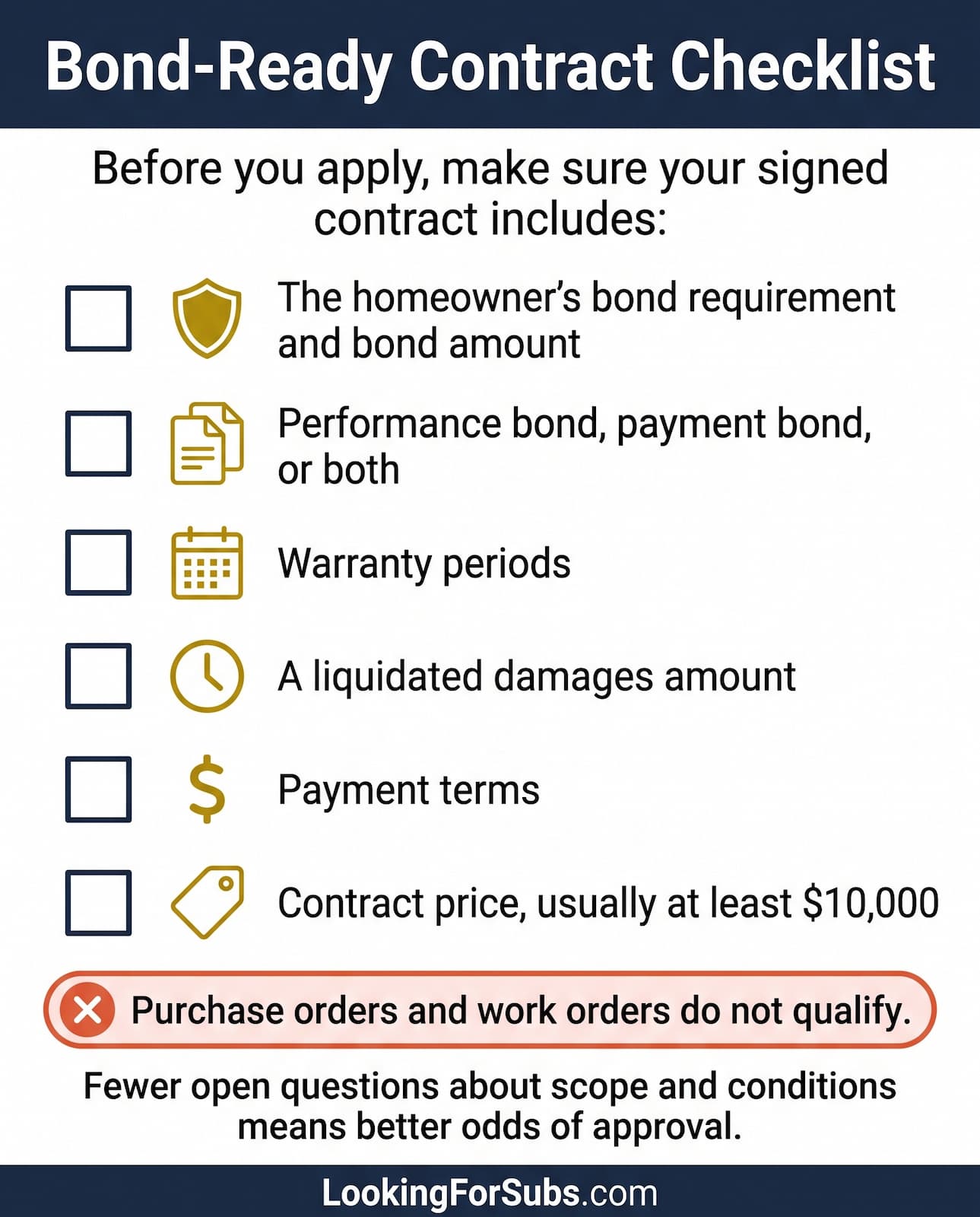
Underwriters move faster when the contract answers their questions up front. Before you apply, make sure the signed contract includes:
- The homeowner's bond requirement and the bond amount
- Whether it's a performance bond, a payment bond or both
- Warranty periods
- A liquidated damages amount
- Payment terms
- A contract price, usually at least $10,000
Purchase orders and work orders don't qualify. The fewer open questions about scope and conditions, the better your odds.
For construction attorneys: the surety supplies its own bond form, and the homeowner's attorney can review it before the contract is signed. That way the bond terms and contract terms line up. There's a guide written for you here: Homeowner Protection Bond for construction attorneys.
A Bond Is Not Insurance
Contractors need to understand this before signing anything.
The business, its owners and their spouses sign a general indemnity agreement. If the surety pays a claim, you and every indemnitor owe that money back, plus the surety's costs and attorney fees. The bond protects the homeowner. The indemnity protects the surety. Treat a bonded job like your house is on the line, because in some cases it effectively is.
A Homeowner Protection Bond also doesn't replace your insurance. It isn't general liability and it isn't workers compensation. You still need the coverage your state and your contract require. Homeowners should verify that coverage independently, and a good contractor welcomes that.
Why It Pays Off Beyond One Job
A bonded residential job builds a track record with a surety. If you ever want commercial or public work, you'll need bonding capacity, and that capacity is built one successfully completed bonded job at a time. A homeowner asking for a bond is quietly an introduction to the market you might want next.
For subs, working under a GC who can get bonded usually means steadier pay and fewer surprises.
How to Apply
- The homeowner writes the bond requirement and amount into the contract.
- You both sign it.
- You complete the Homeowner Protection Bond application and attach the signed contract.
- The business, owners and spouses sign the general indemnity agreement.
- The surety reviews credit, experience, licensure and contract terms, then quotes.
- The surety provides its bond form for the homeowner's attorney to review.
- You pay the premium and the bond issues with the homeowner named as obligee.
Send the homeowner a copy of the issued bond right away. It's the document they'll rely on.
For the full contractor walkthrough, read Your Customer Wants You Bonded: What Contractors Need to Qualify. For complete bond details, FAQs and the application, see the Homeowner Protection Bond page. Applications can be submitted from either page.
Looking for more residential work, or for subs who can keep up with it? Find a subcontractor or list your trade for free on LookingForSubs.com.
LookingForSubs.com is sponsored by AmericasSuretyBonds.com, which places Homeowner Protection Bonds and is compensated when a bond is placed. This article is general information, not legal advice. Bond approval, terms and pricing are set solely by the surety, and every project is underwritten individually.